
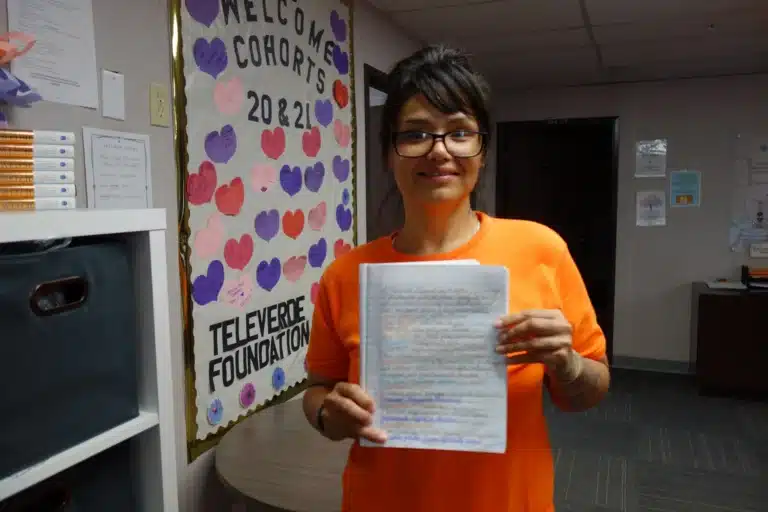
It’s an early February morning. Teresa Prieto stands next to her desk inside a mobile classroom at the Perryville women’s state prison in Goodyear.
She’s working on a personal brand presentation.
“Empathetic and nurturing: I lead with heart and emotional intelligence; and creative and spiritual: I’m guided by intuition, meaning and imagination.”

Her notebook is filled with words that describe the kind of characteristics she wants to embody.
“The fourth one was ambitious and independent because that’s my biggest goal right now is becoming independent.”
Because she’ll be leaving Perryville this month. Prieto is part of a six-month workforce development and re-entry program of the Televerde Foundation in partnership with Arizona State University.
It’s designed to help incarcerated women build personal and professional skills.
“This is my fourth time down and I’ve always done programming,” she explains. “And when the program was there, I was like, ‘Oh, another program!’ And so when they called me, here I come!”
But this time was different. At 33, Prieto is over it. “I was wanting to change so badly, but I didn’t know how.”
Michelle Cirocco is the CEO of the Televerde Foundation.
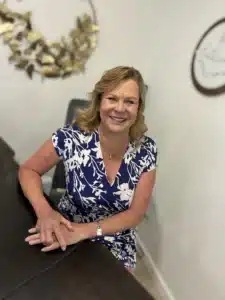
“So depending on how long you’ve been here, whether it’s, you know, six months or 16 years, you’ve lost everything,” Cirocco says. “You’re going to walk out of here with the clothes on your back, which may have come out of a Goodwill box.”
And if a woman doesn’t have a solid support system in place, she may not even have a ride when she leaves prison; let alone a place to stay. Cirocco says that’s why Televerde focuses on more than just resumes and interview skills: The program also centers on trauma recovery.
And that’s often where the shift happens.
“It’s overwhelming,” Prieto says. “You start to realize all the wear and tear your life has put you through. And it becomes so normal and OK, it’s like, ‘yeah, you got all that going on, but let’s like see it for what it is and now build on that.’”
When Prieto leaves, she’ll move into transitional housing, where she can live rent-free for up to four months while saving for her own place.
‘What’s our return?’
Kurt Altman of Altman Law & Policy is also the Arizona and New Mexico state director at Right on Crime, which aims to improve the criminal justice system.
He says Arizona’s prison population surged in the 1990s after lawmakers passed truth-in-sentencing laws requiring people to serve at least 85% of their sentence, along with mandatory sentencing policies.
“I’ve said this before: Our Department of Corrections, we put a bunch of money into it; we invest in it more than we invest in anything else in Arizona; what’s our return?”
Not much, it turned out. Recidivism wasn’t going down, and taxpayers weren’t saving money.
“And for the longest time in Arizona, in every state, and even the federal system, we weren’t getting anything. They were serving their time. Their time was over. They opened the door, maybe gave them $20 — if they were lucky — and said, report to probation or your parole officer within 72 hours. Good luck.”
One of the biggest factors in recidivism — especially for women, he says — is the ability to find a place to live and the ability to get a job.
“If they can’t get a job, they’re not going to be able to find a place to live. And if they don’t have a place to live, guess what they do? They end up — even if they try, even if they make every effort to do it — they end up back in the situation that was a big factor in them ending up in prison anyway.”
A 2021 report on female re-entry found that “while the number of women entering prisons and jails has grown significantly, a corresponding increase in programming has not materialized.”
Gender-informed programming
Dominique Roe-Sepowitz is a professor at Arizona State University and the director of the Office of Sex Trafficking Intervention Research there.
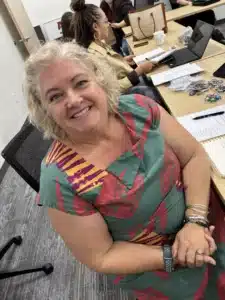
“Incarcerated women are incredibly under-researched,” she says.
So she did the work to try and change that by surveying more than half the women at Perryville.
“They had incredibly high rates of childhood victimization, really high rates of adult victimization, 71.8% of the women in prison were addicted to drugs.”
Televerde Foundation is one example of a program that offers pre and post re-entry support geared exclusively towards women.
Then there’s Bridges Reentry: a totally different model. Founded by Episcopal Deacon Gay Romack, Bridges is a two-year, peer-supported residential program.
“I felt like, if women are going to heal, it takes time. It just takes time,” Romack explains. “And there are a thousand different layers that are involved in really healing in body, mind and spirit.”
Those who come here focus on the 12-step program; they have to get jobs and save their pay and follow the rules — like sticking to a curfew.
“In a year’s time, their whole attitude is different,” she says. “They set goals, they’re being coached and mentored.”
Bridges is an expensive concept and dependent on grants and community donations. Romack jokes she’s become a formidable grant writer, but she’s also seen the payoff: women who have reconnected with their kids, are enjoying careers and even saving enough to buy a home of their own.
Read the original article: Incarcerated women have unique needs. More Arizona programs help them navigate life after release