
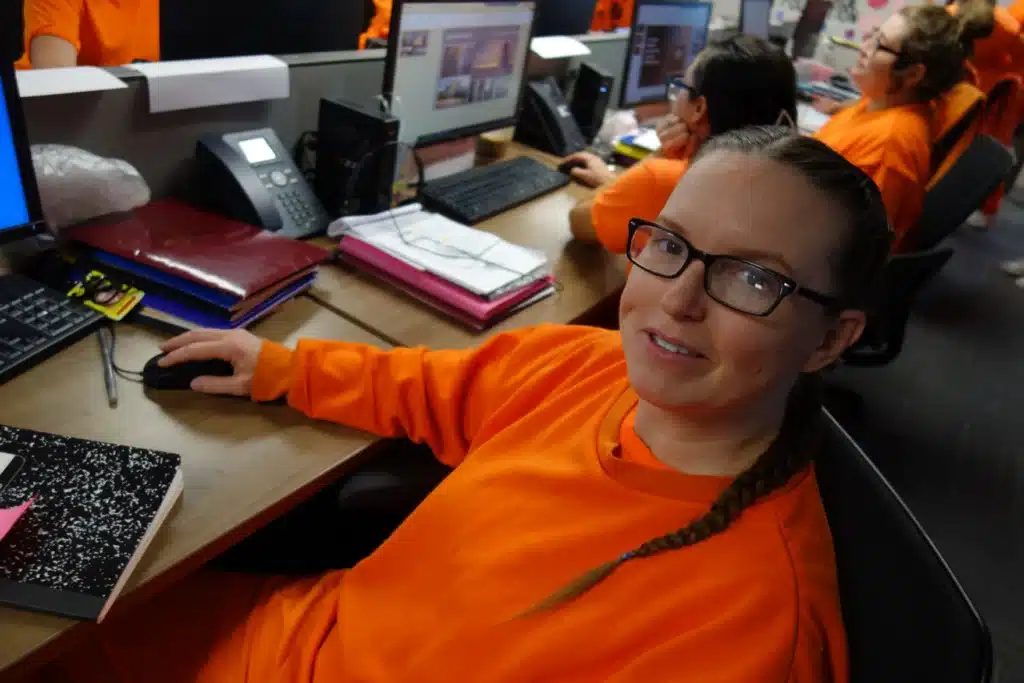
Here is the Televerde Foundation’s Career PATHS, a six-month workforce development and re-entry program that helps incarcerated women build personal and professional skills leading up to their release.
“Learning all the things that I’ve been learning, business development and emotional intelligence, it’s just opened my eyes.”
It’s February, and Mary has about three months left in her three-and-a-half year prison sentence.
“Yeah, I’m really excited about it,” she says. “I have a lot of support and I feel like I’m going to be really well taken care of.”
Prioritizing employment after incarceration
Ray Bandin is the re-entry coordinator with Arizona’s Department of Economic Security. He says for the last decade, the state has made career readiness and employment a focal point. They also collaborate with potential employers, encouraging them to consider hiring people leaving prison.
“Most employers, once they give an opportunity to our clients that have been justice-involved, actually start opening up more doors because they soon realize that our clients tend to be more reliable and tend to show up at work and do an excellent job.”
And he says formerly incarcerated individuals are less likely to commit crime when they have stable employment.
Bandin says upwards of 500 companies in Arizona identify themselves as second-chance employers — meaning they’re willing to hire people with criminal records.
48 hours post-incarceration
It’s May, and Mary was released from Perryville just 48 hours ago. Her hair is down. She’s wearing a light pink top and jean shorts. She’s shining.
“Yeah, it’s different in prison,” says Mary. “You’re just like, plain and dull and you have to have your hair up and there’s the orange color.”
 I first met Mary Clifton in February 2026. She was working on a personal branding project for her ASU class, which partners with the Televerde Foundation to support incarcerated women on their reentry journey.
Mary is staying at a small home run by the Televerde Foundation in downtown Phoenix. She’ll live there rent free while she gets her bearings. Before leaving Perryville, Mary had an interview with a local resort.
“And she said, ‘OK, when you get out, do the application online,’ which I did all that yesterday,” she says. “I applied for several different positions.”
But that wasn’t the only thing on her re-entry to-do list.
“I must get a phone and then I must pay my fines. And then after that I want to get a car. I need to get a car so I can go here and there, you know?”
Getting a car also involves a trip to the MVD to get her license back. Then she has to apply for Medicaid and SNAP benefits.
And she has to check in regularly with her probation officer.
“So I have to have a weekly schedule for her. I have to have everything planned out, which is kind of hard to do because I don’t know this area.”
She says it’s overwhelming — and the clock is ticking.
Second-chance employers
Alison Rapping is CEO of Arouet, a Phoenix nonprofit that supports women before and after incarceration. Arouet also works with second-chance employers.
“Ninty-five percent of all people are going to come out and they’re going to live in our communities,” she explains. “They’re going to be our neighbors, so we want very much to get people ready to enter society and in a most positive way.”
Alison Rapping is CEO of Arouet, a Phoenix nonprofit that supports women before and after incarceration. Rapping says roughly half the staff at Arouet are formerly incarcerated women. She says that diversity in employment is their “secret sauce.”
Still, many employers that are second-chance are not always upfront about it. From an employer’s perspective, hiring someone with a criminal record can feel risky.
But for people who’ve served their sentences, there’s another question: If you do the crime and you do the time, shouldn’t that be enough?
Kim Thomas says in her experience, no. She was 24 years old when she was sentenced to 30 years at Perryville Prison for second-degree murder.
“I have spent every moment since that moment, every moment after that has been in service making amends, making atonement, doing good work and standing up for those who don’t have a voice.”
Thomas got out of prison in 2021, and now she’s the director of community impact at Arouet.
“The fact that I paid my debt and it’s still not paid in most people’s eyes,” she says. “The fact that I can never in my life vote, never in my life serve on a jury, never in my life get a fingerprint clearance card, all these never’s over 37 seconds that happened in 1991.”
Jessica Marone understands that frustration. She left Perryville prison in 2018. Now, she also works at Arouet, helping other women connect with second-chance employers.
Kim Thomas jokes that she’s older than Google. And when she left Perryville Prison in 2021 after serving 30 years, the world was a very different place. “The only way for me to wrap my brain around that as I was getting ready to come home was to set my mindset to: I’m not going to be someone releasing from incarceration. I’m going to be a tourist in a foreign country.”
“So by and large discrimination is illegal, but there’s one sect of people that it is 100% legal to discriminate against,” she says. “A company can say, ‘I will not hire you because of your criminal background.’ A rental property management company will not rent to you because of your criminal background.”
The U.S. Chamber of Commerce estimates the nation’s economy loses up to $87 billion per year by excluding formerly incarcerated individuals from the workforce.
“We can’t afford to have everybody who comes out with a felony unable to get a job that moves into a livable wage job because then we also create an intergenerational crisis,” she explains. “This affects their children then it affects their children’s children.”
As for Mary Clifton, she got a job at a local resort and she says she’s doing well. She’s saving money and plans to reunite with her husband and kids.
Read the original article on KJZZ: To really start over, formerly incarcerated women need jobs. Criminal records make it harder